
Running two
large-scale GDS discoveries for Natural England
Discovery | User interviews | Persona development | Hypotheses | Journey Mapping | Data analysis
Natural England have recently created a new programme to improve services that are considered critical enablers of their strategic objectives for the next 5 years. Of these, two services have been prioritised. The goal of our discovery was to build a holistic understanding of internal and external user needs to inform future improvements to the services and underpin a shift to digital delivery aligned with the Government Service Standard.
Key challenges in the project
Overlapping services, distinct needs
Running two related but separate discoveries (with distinct services, problem statements, and stakeholder groups) meant juggling shared users, systems, and journeys while keeping each service’s scope clear and actionable.
Complex organisational ecosystem
Navigating Natural England’s internal structures—central teams, area teams, marine vs terrestrial, national specialists—required time to understand roles, responsibilities, and where processes broke down.
External user diversity
The range of different types of external users we had to investigate was huge, from users in other government bodies to private landowners, trusts and 3rd party agents. I had to balance and prioritise how we segmented our research to ensure we were representative while managing timescales and project deadlines.
Scope vs. time
Discovery was ambitious in scope and tight on time. We had to prioritise research activities that would yield the most actionable insight for alpha, while acknowledging some gaps would need to be picked up later.

As a user researcher on the project, I was presented with the challenge of leading research across two concurrent discovery projects. I had to develop an approach to explore overlapping users, journeys, internal systems and structures while acknowledging each service's independent needs, outcomes and stakeholder groups.
Running two discoveries concurrently
Kick-off workshop and problem statements
To kick-off the discoveries, we ran a discovery kick-off workshop and several problem statement ideation workshops.
This enabled to team and core stakeholders to gain a deeper understanding of the problems to investigate, key service outcomes, and discovery scope. From this, we developed a set of high level problem statements, discovery goals and a research plan to give us direction throughout the project.


Our discovery approach
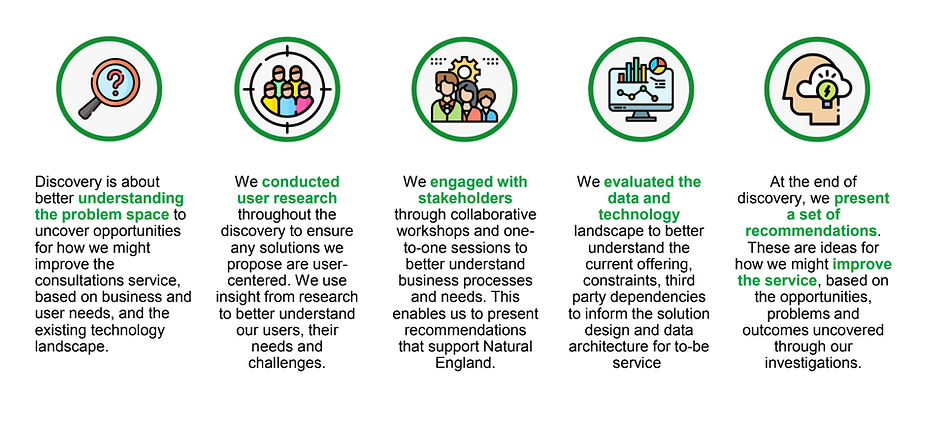
Agile ways of working
Developing a research plan

Understanding users and their context
Due to the scope and complexity of the research in this discovery, we broke the research activities down into several stages (with an initial desktop research stage and final consolidation stage), focusing on specific user groups or service journeys in each.

Who are our users?
Across both services, I recruited and interviewed over 100 different users (both internal and external) from a broad spread of user groups (both internal and external) and locations.
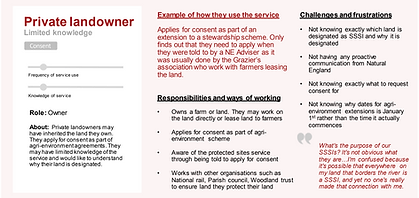
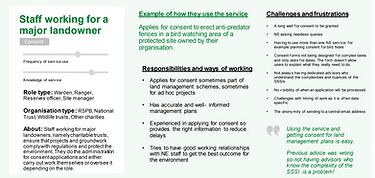
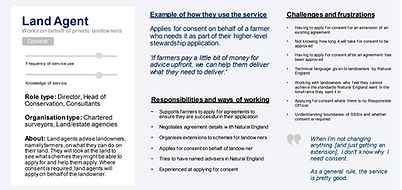
From these interviews and wider desktop research, I developed a research report detailing all key themes around user needs, behaviours, and motivations, as well as a set of core personas highlighting pain-points and opportunities.
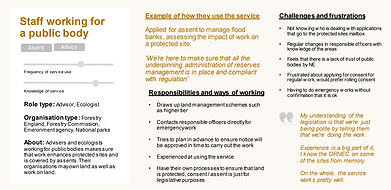


A service blueprint
I also mapped the key user journeys that the different user groups would typically take, based on the findings from our research across both services.
We focused on exploring the interactions between services and both internal/external users to better understand the wider context of the service journeys.
User needs, hypotheses and riskiest assumptions to test in alpha
As a main outcome of the Discovery phase, we defined a set of user needs, hypotheses and riskiest assumptions to test in alpha.
I led a two day in-person hypothesis development workshop with the delivery team to translate our user needs and pain-points into hypotheses to test in Alpha.


Outcomes of discovery
Discovery is completed when the team have enough confidence about a problem space to make informed decisions on whether to progress to alpha and start testing hypotheses. Following completion of our research, we developed a set of evidenced problems to solve, and potential solutions to explore.
Priority problems to solve
Recomendation


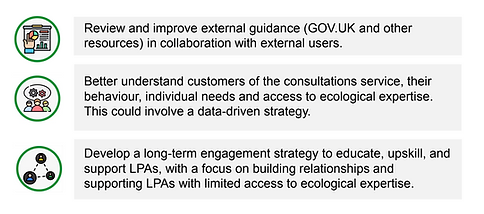
Proposed alpha roadmap and beyond

End of discovery workshop
To conclude our discovery, we ran a half-day workshop with the delivery team and key stakeholders to discuss our findings and next steps.
In the workshop, we interrogated the findings from our user research, and discussed feasibility of potential solutions.
From this workshop, we were able to align our stakeholders and develop a high level plan for alpha, prioritising our riskiest assumptions to test first.

Tom has gone above and beyond anything anyone expected in terms of volume of research undertaken, analysis of that material and research outputs. I mean seriously, it's been forensic! He also played a significant part in structuring the discovery report and helping the whole team come to well justified hypotheses. Excellent tools and techniques applied with skill at every stage to help us get to where we needed to be. I honestly LOVE working with him. Just a really decent human and fab team player. I think he raised the bar of UR with what he did on this project.
Cath Jones
Service Designer
Natural England
This project showed the value of effective planning and research coordination when investigating overlapping services. By deep diving into pain-points and user journeys, we uncovered shared challenges and opportunities. Although challenging, running both discoveries together helped connect the dots, reinforcing how crucial collaboration and agile delivery are for delivering joined-up, user-centred public services.