
Discovery | Agile user research framework | User interviews | Recruitment | Collaboration | Stakeholder management
I joined the Fish Export Service at the Marine Management organisation during a time of rapid change, as the the programme teams were being restructured. I was tasked with leading user research for a new team; introducing improved processes for planning and prioritising research, and supporting a discovery for upcoming EU regulation changes.
Some background
The Fish Export Service was introduced to enable the exportation of fisheries products to EU countries following Brexit. The service has been active since 2021, although the teams supporting the development and maintenance of the service have evolved multiple times since.
Following an internal audit, in which a number of inefficiencies and poor work practices were identified, a core team was created to support better cross-functional delivery. I joined the programme to lead research for the service as part of this new team.
The challenges I faced
Entirely new team with no established processes or experience working agile or GDS.
Research direction had historically been driven by senior leadership focused on the digital service, leading to a limited understanding of the wider context.
A fixed deadline for delivery of new EU regulations on the service.
The team had never run a GDS discovery before.
Complex stakeholder landscape across multiple devolved governments
Fragmented, missing and poorly documented previous research on the service
How I approached the programme
Defining the role of user research
When joining the team, I wanted to first understand the team's maturity and understanding of user research. I engaged with senior leadership and various team members to unpick the history of the service, and how research had been conducted previously.
It became clear to me that user research had solely been responsible for usability testing, with limited scope for wider foundational research.
To shift this mentality in the team, I ran a number of sessions introducing the role of user research, and how it can support wider investigation of the problem space, user needs and service context.

Up-skilling on UCD and the Government Service Standard

Alongside the sessions introducing the role and responsibilities of user research, I also ran a number of workshops to upskill the team on user-centred design and the Government Digital Service.
These principles of delivery were new to the majority of the team, who had historically followed solution-led, waterfall delivery methods.
To ensure that we were delivering solutions that solved real user needs and problems, and delivered a service that met the Government Service Standard, these sessions were designed to introduce new ways of thinking about how we deliver
Introducing a research framework to the team
As this was a new team, it was important to introduce a user research process that ensured we were able to manage shifting priorities while gaining an understanding of users that had the biggest impact to developing a successful service. This structured approach guides the process of conducting user research, including the methods, techniques, and guidelines used to gather insights about users and inform decision-making in more complex programmes of work.
1. Supports more holistic outcomes by aligning research activities with programme-wide priorities.
2. Helps user research plan, prioritise and manage time more effectively – especially when presented with multiple potential research routes.
3. The structured approach creates consistency, saves time and promotes efficiencies by having a view of multiple research needs.
4. Fosters better cross-functional collaboration while managing team expectations.
5. All this in turn provides team members with the necessary evidence to support key decision making that benefits the whole service.
Components of the framework
1
A robust research toolkit and processes
Good research processes are essential for enabling user researchers to effectively undertake research at pace, fully involve the team at each stage, and follow best practices and codes of conduct.
I introduced the following tools and processes as part of the framework:
- A user research backlog
- A collaborative agile workflow
- A suite of user research templates
- A centralised knowledge repository
- A participant recruitment process
- Secure data storage and governance


2
A clear definition of research streams
With a good research toolkit and process established, we can begin to run research. Research in a live service can broadly fit into 3 core types, all with varying levels of scope.
Strategic research: This is wider, more generative/exploratory user research. Focuses on gaining a deeper understanding of the user and their experiences, including what happens before, during, and after using the service. Outcomes are more holistic - driving longer term and larger scale decisions for the service.
Tactical (or evaluative research): Focuses on improving a specific product or feature, and usually results in immediate recommendations or changes. Typically involves evaluative research of a user journey on the live service or proposed designs/prototypes.
Maintenance research:This focuses on active monitoring and actioning of feedback from users of the live service based on defined success metrics. We want to measure the impact of our service and uncover opportunities for further improvement.
3
A working user research roadmap
Finally, a supporting user research roadmap was developed to align research activities with longer-term programme and product roadmaps. This enabled the team to understand what research was happening, when, and why.
The roadmap was developed by working with product and programme managers, as well as senior leadership, to connect research activities with delivery priorities while managing stakeholder expectations
The roadmap was a working artefact, reviewed on a monthly basis to ensure that our research backlog was aligned with current and future programme priorities.

User research activity lifecycle

Running a discovery
About the discovery
The EU was making changes to the IUU (illegal, unreported and unregulated fishing) regulations, which will be mandated from 10th January 2026.
As a result, the core team were tasked with investigating and implementing changes to the Fish Export Service to ensure compliance with new regulations.
Discovery research was undertaken to investigate the problem space and determine how best to update the service to reflect new EU regulations and support users with compliance.
Our goal:
To investigate whether users can provide the necessary information that will be required to apply for catch certificates and identify opportunities for supporting users with compliance when the EU regulation changes are mandated.
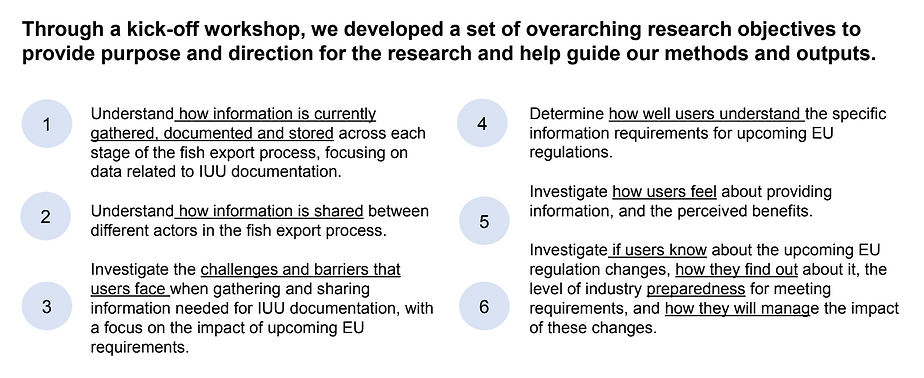
High-level user research plan

What we found
Segmenting our users
I adopted a mixed methods approach to better understand who are the key users of the service. In total, we ran 40+ qualitative interviews, and quantitative analysis of registered users of the service.
We segmented both primary and secondary users of the service, and grouped them into distinct user profiles based on their background, behaviour and service usage.
These profiles were used to support the team in understanding different user needs and pain-points, as well as mapping various user journeys and interactions between actors.


Mapping the service
Using the insights from our research (including internal user and stakeholder interviews), I mapped the as-is service against different user groups.
Additionally, I mapped user needs and pain-points to the map to identify areas that presented particular challenges with the upcoming EU regulatory changes.
User needs and assumptions log
I created an assumptions log for the team to use throughout the discovery. Our assumptions and unknowns were developed from a number of workshops, with the status tracked throughout discovery.
Once we had validated an assumption, we updated the log and referenced the evidence gathered from research.
Additionally, we created a user needs log for alpha hypothesis testing.
